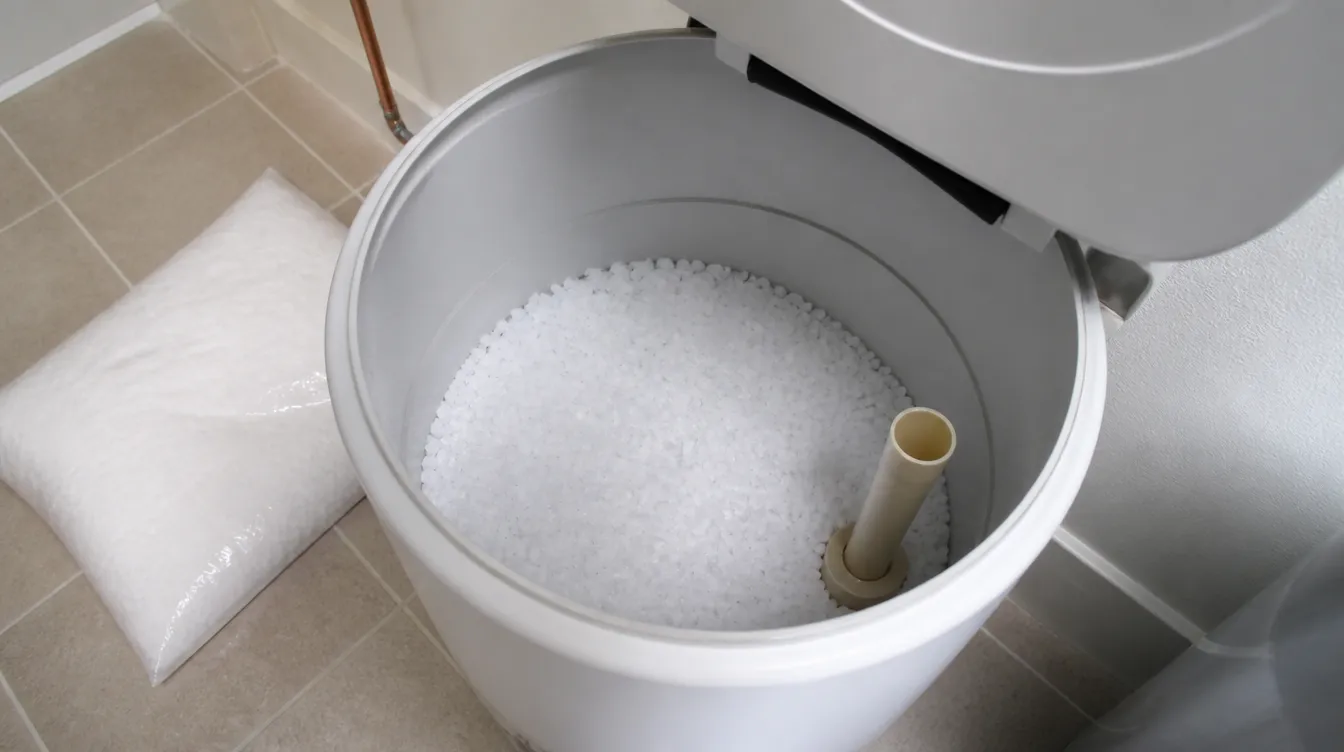
Pellets or crystals, how many bags a month, why the tank bridges, and what salt has to do with the sodium in your water. A practical guide for Front Range homes.
A softener does not consume salt to filter your water. It uses salt to clean itself. Understanding that one distinction explains everything else on this page.
What the salt is actually for
Inside the tank is a bed of resin beads. Hardness minerals, calcium and magnesium, stick to the beads and sodium is released in their place. That is ion exchange, and it is the entire mechanism.
Eventually the beads are full of hardness and cannot hold any more. So the valve runs a regeneration: it draws a strong brine solution from the salt tank, floods the resin with it, and the sheer concentration of sodium strips the calcium and magnesium off the beads. That hardness goes down the drain, and the beads are ready again.
So salt goes into the brine tank, not into your drinking water on purpose. What ends up in your water is the sodium the resin released during normal service.
Which salt to buy
| Type | What it is | Worth it? |
|---|---|---|
| Evaporated pellets | Highest purity, around 99.5% sodium chloride | Yes. Cleanest tank, fewest problems. What we recommend |
| Solar crystals | Sun-evaporated sea salt, slightly less pure | Fine, cheaper, more residue over the years |
| Rock salt | Mined, lots of insoluble minerals | No. It is the usual reason a brine tank turns to sludge |
| Potassium chloride | Adds potassium instead of sodium | Only for sodium-restricted households. Several times the price |
| Block salt | Solid blocks for specific cabinet units | Only if your unit was designed for it |
Two more practical notes. Salt sold as “for softeners with rust remover” contains a citric-acid additive that helps on iron-bearing water, which matters on some wells. And whatever you pick, stay with it, because mixing types is one of the most common causes of bridging.
How much you will actually use
There is no single answer, because usage is driven by three things: your hardness, how much water the house uses, and how the valve is set.
Rough arithmetic, for a sense of scale: a family of four in Thornton, where the city publishes about 11.7 grains per gallon on average, is removing far more hardness per week than the same family in Boulder at 2.4 gpg, and will go through proportionally more salt. Check the tank monthly and buy to match.
The two problems everyone eventually has
Bridging. A hard crust forms across the top of the salt with an empty gap underneath. The tank looks full, the softener has nothing to draw, and your water quietly goes back to being hard. Fix: break the crust up with a broom handle, and keep the tank only a third to two-thirds full.
Mushing. Dissolved salt recrystallizes into a sludge at the bottom, which blocks the brine line. This is what cheap rock salt does over time. Fix: scoop it out, rinse the tank, start again with pellets.
Both are much less likely if you buy clean salt, keep the tank under two-thirds full, and let it run down before refilling.
Salt, sodium and drinking water
This is the part the industry glosses over, so here is the number. Ion exchange adds about 0.46 mg/L of sodium for every 1 mg/L of hardness removed. On Thornton water at its published average of about 200 mg/L, that is roughly 92 mg/L of added sodium.
For most people that is not a health concern, but it is a real change, and if someone in the house is watching sodium it is worth planning around. Two ways to do that:
- Leave one cold tap unsoftened, usually the kitchen, for drinking and cooking.
- Add reverse osmosis at the kitchen sink, which removes most dissolved solids including that sodium. This is what most of our hard-water customers end up doing anyway, because it also handles taste.
Colorado-specific: is any of this restricted?
We found no state or local ban on brine-discharging softeners in Colorado, unlike several California cities that do restrict them. Colorado’s domestic-supply chloride standard is 250 mg/L, and brine rules here apply to treatment plants rather than homes.
What is true is that salt-free conditioners have a genuine appeal in a dry state: no salt to haul, no brine, no regeneration water. The honest trade-off is that they do not remove hardness. The mineral is still in the water, so a hardness test looks the same before and after, which is exactly why our money-back guarantee does not cover that kind of unit.
Sources
- City of Thornton: water hardness made easy — about 200 mg/L average (11.7 gpg)
- City of Boulder: drinking water quality — 42 mg/L average (2.4 gpg)
- Sodium addition from ion exchange: ~0.46 mg/L per 1 mg/L hardness removed — our calculation applied to published hardness
- Colorado water quality standards for chloride in domestic supply (250 mg/L) — no residential softener restriction found in Colorado
Common questions
What kind of salt should I use in a water softener?
Evaporated salt pellets are the cleanest and leave the least residue. Solar salt crystals work and cost less but contain more insolubles, which build up in the brine tank over time. Rock salt is the cheapest and the dirtiest; it is the usual cause of a sludgy tank.
How much salt does a softener use per month?
It depends on your hardness, your water use and how the valve is programmed. A metered softener on hard Front Range water in a family home commonly lands somewhere around one to two 40 lb bags a month. Harder water and more people means more salt.
Can I mix salt types?
You can, but it is better not to. Switching between pellets and crystals is a common cause of bridging, where a crust forms over an empty space in the tank and the softener stops drawing brine.
Does potassium chloride work instead of salt?
Yes, and it adds potassium instead of sodium. It costs several times more and is slightly less efficient, so plan on a little more of it. It is worth considering if someone in the house is on a sodium-restricted diet.
How full should the brine tank be?
Keep it between a third and two-thirds full, and always above the water level. Filling it to the brim makes bridging more likely, not less.