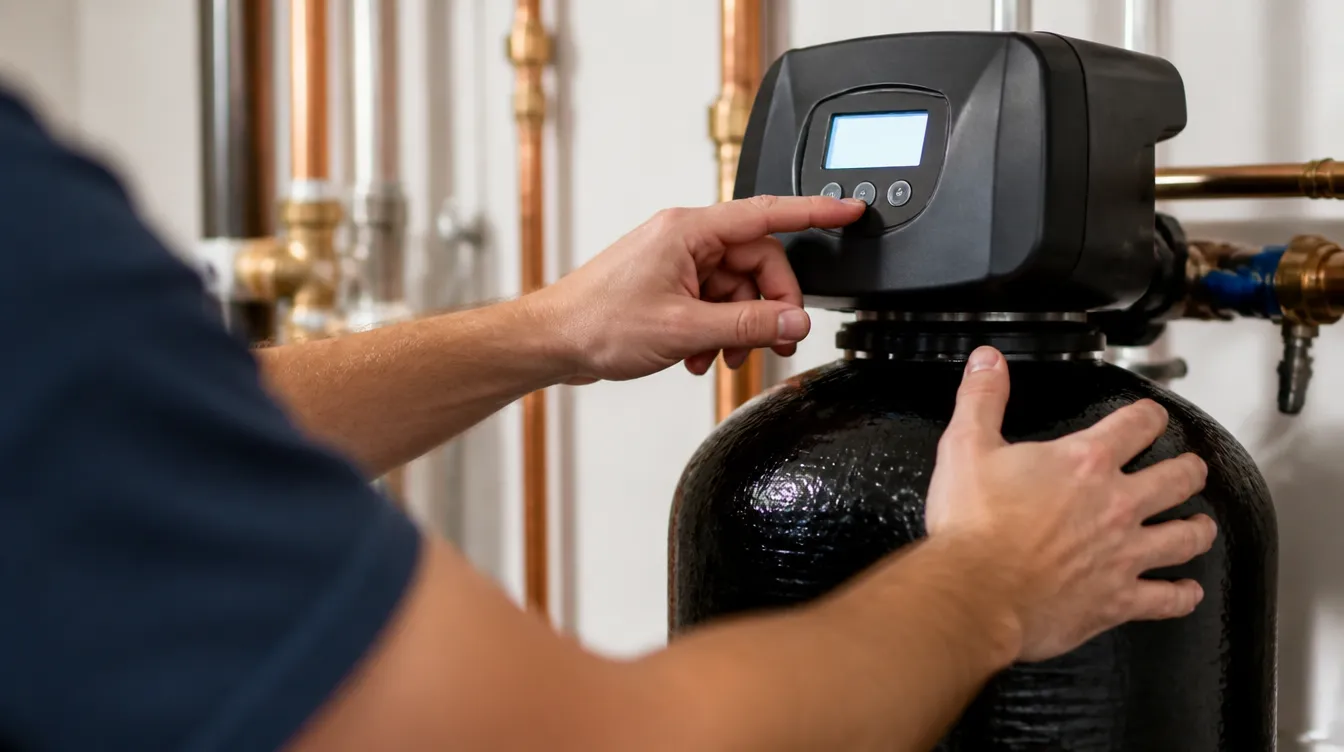
A softener is mostly self-cleaning. Five minutes a month and one check a year keeps it working, and tells you early when something is wrong.
A water softener is one of the few appliances that cleans itself. The maintenance list is genuinely short, and most failures are not failures at all, they are neglected salt or a setting that drifted.
Monthly: two minutes
Look in the brine tank. You are checking three things:
- Salt level. Between a third and two-thirds full. Not brimming.
- A crust. Push a broom handle down through the salt. If you hit a hard shelf with a gap underneath, that is bridging, and the softener has been running on nothing. Break it up.
- Water level. There is normally some water in the bottom. A tank full of water to the top means the valve or drain is not cycling properly.
That is it. Everything else is annual.
Annually: fifteen minutes
1. Test your hardness. At a softened cold tap. The point is not curiosity, it is catching drift. Our target after install is under 1 grain per gallon; if you are reading 3 or 4 a year later, something changed.
2. Check the settings. A metered valve stores your hardness setting and household size. Power outages and well-meaning tinkering both move them. If your hardness setting is wrong, salt use and softness both go wrong with it.
3. Look at the bypass. A bypass valve left half open is a surprisingly common cause of “it doesn’t seem to be working.”
4. Clean the brine tank if it needs it. Every two to three years on pellet salt. Sooner if you have used rock salt and there is sludge in the bottom.
5. Check the drain line. It should be secured above the drain with an air gap, not pushed down into the pipe. That air gap is what prevents dirty water being siphoned back.
What wears out, and when
| Part | Typical life | What happens |
|---|---|---|
| Resin | 10 to 15 years, less on chlorinated water | Loses capacity gradually; you notice hardness creeping back |
| Valve seals and piston | 5 to 10 years | Leaks, sticking cycles, running constantly. Rebuild kits exist and are cheap |
| Brine valve / float | 5 to 10 years | Overfilling or underfilling the brine tank |
| Control board | 10 years+ | Display dead, no regeneration |
| Tank | 20 years+ | Rarely the problem |
The reason we install softeners on an open-platform metered valve is exactly this table: the wear parts are standard, available and rebuildable by any plumber. A proprietary unit that only one dealer can service puts you in a worse position in year eight.
The Colorado-specific bit: chloramine and resin life
Most of the Denver metro disinfects with chloramine, including Denver Water, Aurora, Thornton, Westminster and Castle Rock. Chlorine and chloramine are hard on softener resin, and they shorten its life.
Two practical consequences:
- Ask for chloramine-tolerant resin (higher crosslink) if you are on any of those systems.
- Carbon before the softener is not just for taste. A catalytic carbon tank upstream removes the chloramine before it reaches the resin, which is why every complete system we install runs sediment, then carbon, then softener, in that order. You can see the chain on how it works.
Symptom to cause
| What you notice | Most likely cause |
|---|---|
| Spotty glassware and soap not lathering | Salt bridge, empty tank, or a bypass left open |
| Softener runs constantly or water hammer | Valve piston or seals |
| Salty-tasting water | Regeneration not rinsing fully, often a drain restriction |
| Brine tank full of water | Brine valve, float, or drain line problem |
| Going through salt much faster than before | Hardness setting changed, or a leak causing constant use |
| Hardness slowly returning over years | Resin nearing the end of its life |
What a service visit should include
If you pay someone to service a softener, the visit should include a hardness test at the tap, a forced regeneration watched end to end, a settings check against your actual hardness, a look at the brine well and float, and a drain line inspection. Anything less is a salt delivery.
Sources
- Utility Consumer Confidence Reports for Denver Water, Aurora, Thornton, Westminster and Castle Rock — chloramine as the disinfectant across most of the metro
- Manufacturer service documentation for open-platform metered control valves — wear parts, rebuild kits and expected service intervals
Common questions
How long does a water softener last?
A quality metered softener commonly runs 10 to 15 years or more, and the parts that wear out are serviceable. Resin gradually loses capacity, faster on chlorinated or chloraminated water, and valve seals and pistons are rebuildable rather than replaceable.
How often should I add salt?
Check monthly. Keep the tank between a third and two-thirds full, and let it run down before refilling rather than topping it up constantly, which is what causes bridging.
Do I need to clean the brine tank?
Every couple of years is plenty if you use clean pellet salt. If you have been using rock salt, expect sludge at the bottom and plan on scooping it out.
How do I know my softener has stopped working?
The water tells you first. Spotting on glassware, soap not lathering, a film in the shower, or scale coming back on fixtures. Confirm with a hardness test at a softened cold tap rather than guessing.
Should I bypass the softener when I go on vacation?
No need for a normal trip. A metered valve regenerates based on use, so little use means little regeneration. For a month or more away, close the bypass and shut off the water like you would anyway.