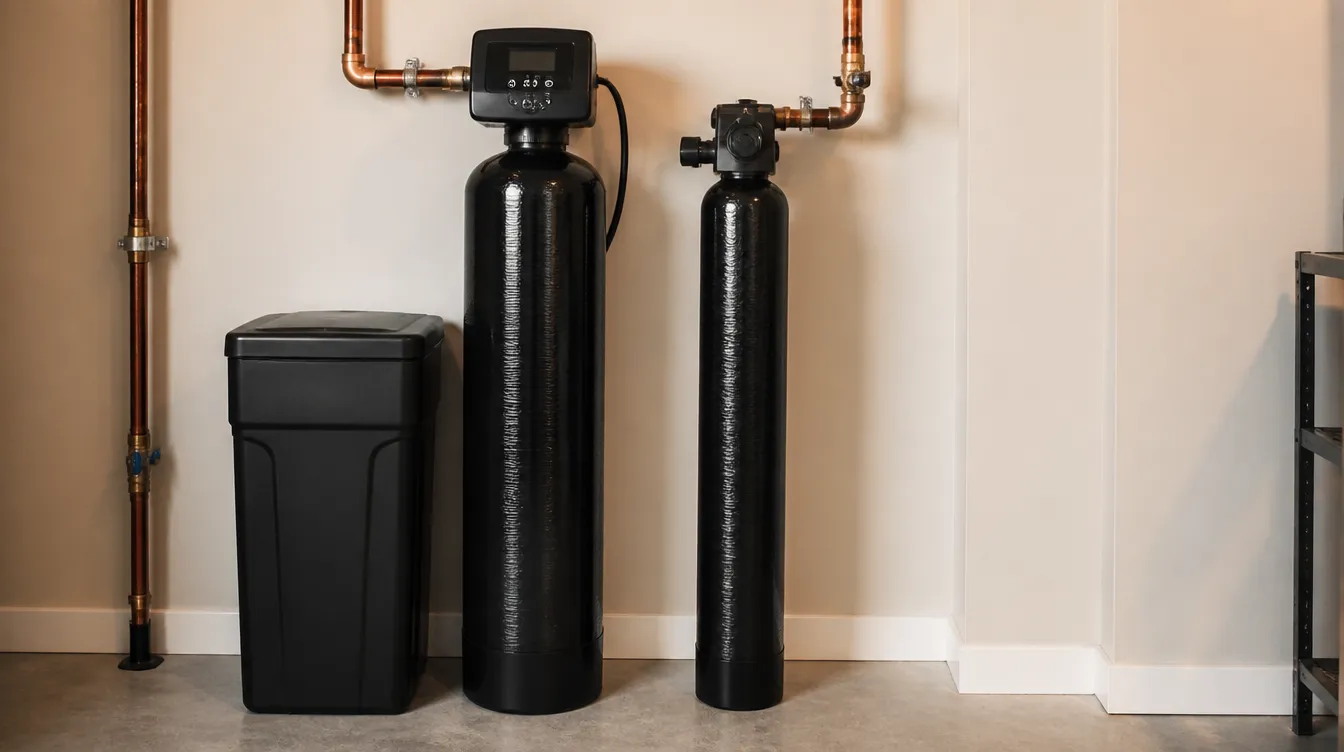
A salt-free conditioner does not soften water. It changes how the minerals behave. That distinction decides whether your hardness test can change, and whether anyone can guarantee a result.
Search “salt-free water softener” and you will get two camps shouting at each other. The disagreement is mostly a naming problem, and once you see it, choosing is easy.
They are two different machines
A salt-based softener removes hardness. Water passes through resin beads that hold calcium and magnesium and release a small amount of sodium instead. The minerals leave your water and go down the drain during regeneration. This is ion exchange, and it is the only one of the two that changes your hardness number.
A salt-free conditioner does not remove anything. The most common type, template-assisted crystallization, gives the dissolved minerals a surface to form into tiny stable crystals. Those crystals are less inclined to stick to pipe walls and heating elements. The calcium and magnesium are still in your water, still measurable, just in a form that is less likely to build scale.
That is the whole difference, and everything below follows from it.
| Salt-based softener | Salt-free conditioner | |
|---|---|---|
| Removes calcium and magnesium | Yes | No |
| Hardness test after install | Under 1 gpg | Essentially unchanged |
| Scale prevention | Yes | Partial, by changing crystal form |
| Spotting and soap scum | Noticeably better | Little change |
| The “soft water” feel | Yes | No |
| Needs salt | Yes | No |
| Needs a drain line | Yes | No |
| Needs electricity | Yes, for the valve | Usually no |
| Adds sodium | Yes, proportional to hardness removed | No |
| Wastes water regenerating | Yes, periodically | No |
| Can we guarantee a measured result? | Yes: under 1 gpg | No |
Why a dry state makes the salt-free pitch attractive
The case for salt-free in Colorado is real, and it is not about chemistry:
- No 40 lb bags to haul down the basement stairs
- No brine tank to maintain, and nothing to bridge or turn to sludge
- No regeneration water going down the drain, in a state where that matters
- No added sodium, which matters to some households
- Nothing to plug in
If that list is what you care about most, and scale in the water heater is your only real complaint, a conditioner is a defensible purchase.
Why we sell salt-based
Because our offer is a measured number, and only ion exchange changes it.
Scale reduction from conditioners is a real effect with independent test support, but it happens inside your pipes over months. There is no way to stand in your kitchen on install day and show you it worked. That makes it a promise, not a proof, and this business is built on proof.
What about the “healthier minerals” argument?
You will see the claim that salt-free is better because it keeps beneficial calcium and magnesium in your drinking water. Two honest points:
- The World Health Organization finds no convincing evidence that hard water is harmful, and notes calcium and magnesium in water may contribute to intake. So there is nothing wrong with drinking hard water.
- If that matters to you, the simplest answer with a softener is to leave a cold tap unsoftened, usually at the kitchen, or to use reverse osmosis there. You get scale protection through the house and untouched or fully filtered water in the glass.
Sodium: the number you should actually ask about
Ion exchange adds roughly 0.46 mg/L of sodium for every 1 mg/L of hardness removed.
- Denver Water at about 95 mg/L hardness: roughly 44 mg/L of added sodium.
- Thornton at about 230 mg/L: roughly 106 mg/L of added sodium.
For context, that second number is a real change worth planning around, though it is still modest next to most processed food. If someone in the house is on a sodium-restricted diet, we recommend an unsoftened drinking tap or RO, and we will say so during the test rather than after the install.
How to decide in one question
Do you want the hardness number to change, or do you just want less scale?
- Number changes, spotting stops, soap works better, and someone can prove it: salt-based, and we will put the target in writing.
- No salt, no drain, no electricity, and scale protection is enough: a conditioner is reasonable. We do not install them, and we would rather tell you that than talk you out of what you want.
And if you are in Boulder, Longmont or Fort Collins on city water, this entire debate is moot. Your water is already soft, and neither machine has anything to do.
Sources
- World Health Organization, hardness in drinking water — no convincing evidence of adverse health effects; calcium and magnesium contribution to intake
- Utility Consumer Confidence Reports for Denver Water and Thornton — hardness values used in the sodium calculations
- Colorado water quality standards, chloride in domestic supply (250 mg/L) — no Colorado residential softener or brine restriction found
Common questions
Does a salt-free water softener actually soften water?
No. Salt-free systems are conditioners. They change the form of the calcium and magnesium so it is less likely to stick to surfaces, but the minerals stay in the water. A hardness test reads essentially the same before and after.
So are salt-free systems useless?
No, but they solve a narrower problem. Template-assisted crystallization has independent test support for reducing scale formation on heat exchangers. If your only concern is scale in pipes and heaters, and you do not want salt or a drain line, it is a legitimate choice.
Why won't you guarantee a salt-free system?
Our guarantee is built on a number changing between the before and after test. Hardness does not change with a conditioner, and scale reduction cannot be measured inside your plumbing on install day. We will not promise something we cannot measure at your house.
Do salt-free systems help with soap and spotting?
Generally not much. The slippery feel, the easier lather and the end of spotty glassware come from actually removing the calcium and magnesium, which only ion exchange does.
Is salt bad for septic systems in Colorado?
We found no Colorado ban on brine-discharging softeners, and no state septic prohibition. Colorado's chloride standard for domestic supply is 250 mg/L, and brine rules here target treatment plants, not homes. Several California cities do restrict them, which is where most of the alarm online comes from.