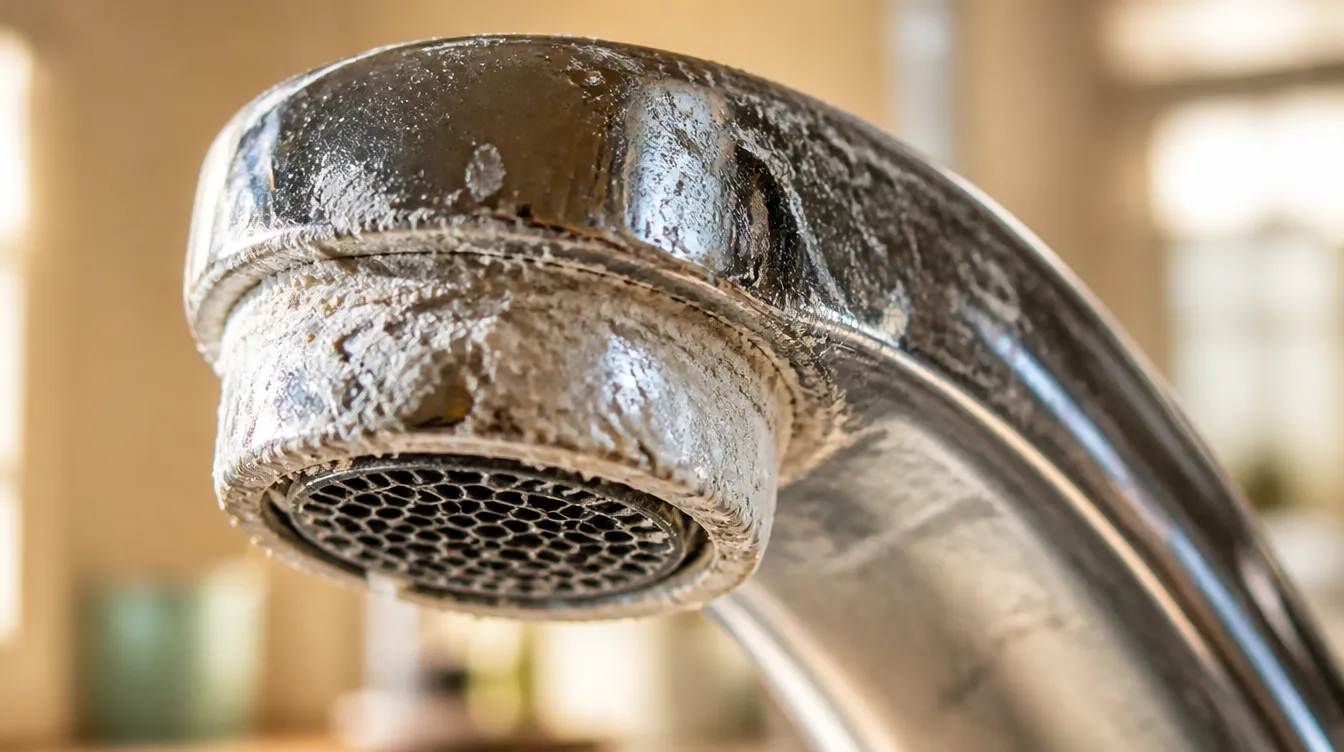
What your water utility publishes for hardness and disinfectant, from Thornton at 13.5 grains per gallon to Boulder at 2.4, and what each number means for your house.
Every water utility on the Front Range publishes its hardness. Almost nobody reads it, because it is buried in a PDF and printed in milligrams per litre while every softener on the market is sized in grains per gallon.
Here is the whole region in one table, converted, with the disinfectant each utility uses.
| City | Hardness (grains per gallon) | How hard | Disinfectant | Source |
|---|---|---|---|---|
| Thornton | 11.7 average; 8.2 in winter, up to 14.6 in summer | Very hard | Chloramine | City of Thornton |
| Pueblo | 10.5 average | Very hard | Not published | Pueblo Water |
| Castle Rock | 6.6 to 10.8 | Hard | Chloramine | Castle Rock Water |
| Aurora | about 8 (136 ppm average) | Hard | Chloramine | Aurora Water |
| Westminster | 7 to 8 (2021 data) | Hard | Chloramine | City of Westminster |
| Denver | not published as a number | Moderately hard | Chloramine | Denver Water |
| Arvada | about 5 (84 mg/L average) | Moderately hard | Free chlorine | City of Arvada |
| Colorado Springs | not published | Not published | Not published | Colorado Springs Utilities |
| Boulder | 2.4 average | Soft | Free chlorine | City of Boulder |
| Longmont | 1 to 2 | Soft | Not published | City of Longmont |
| Fort Collins | not published as a number; the city calls it naturally soft | Soft | Free chlorine | Fort Collins Utilities |
| Greeley | not published | Not published | Free chlorine | City of Greeley |
How to read your own number
Divide mg/L by 17.1 to get grains per gallon. Then:
| Hardness | Grains per gallon | What you notice |
|---|---|---|
| Soft | Under 1 | Nothing. Soap lathers easily |
| Slightly hard | 1 to 3.5 | Little to no scale |
| Moderately hard | 3.5 to 7 | Some spotting, mild scale over time |
| Hard | 7 to 10.5 | Visible scale on fixtures, spotty glassware |
| Very hard | Over 10.5 | Crust on shower heads, film on everything |
The three groups on the Front Range
Very hard: Thornton and Pueblo
Thornton publishes two useful figures. Its hardness page puts the average at about 200 mg/L (11.7 grains per gallon), ranging from about 140 mg/L (8.2 gpg) in winter to as much as 250 mg/L (14.6 gpg) in summer. Its 2026 report, covering 2025 data, shows 152 to 356 mg/L with an average near 230 mg/L (13.5 gpg). Either way, it is the hardest municipal water we found on the Front Range, and the city states plainly that its plants do not treat for hardness.
Pueblo Water publishes 180 mg/L (10.5 gpg) as its average, and posts a live reading that has run higher.
Thornton also runs chloramine and has a documented seasonal taste problem. The city names geosmin and 2-MIB from summer algae as the cause, and tells residents to use an activated carbon filter at the tap or install an under-sink filtration system. That is worth knowing: the utility itself is pointing at the fix.
Hard: Castle Rock, Aurora, Westminster
All three use chloramine, and all three land in the hard band.
- Castle Rock states 6.6 to 10.8 grains per gallon (108 to 125 ppm) in its own FAQ. It blends Denver Basin groundwater with renewable surface water.
- Aurora publishes an average of 136 ppm with a range of 87 to 198, which works out to about 8 grains per gallon.
- Westminster published 113 to 128 ppm, “approximately 7 to 8 grains per gallon,” in its 2022 report covering 2021 data. Newer Westminster reports are published in an online viewer without a downloadable file, so that is the most recent figure we can quote directly.
Moderate: Denver and Arvada
Denver Water does not publish a hardness number. Its hardness page says the supply “can be classified as soft to moderately hard,” notes the water is slightly harder in winter and softer from late spring through fall, and says the southern collection system is moderately hard while the northern system is somewhat soft.
That matters, because several filtration companies publish confident Denver hardness figures that contradict each other and the utility. If you see one, ask for the source. More on Denver water.
Arvada does publish: 20 to 100 mg/L with an average of 84, about 5 grains per gallon. It uses free chlorine, and the city notes the chlorine odor is stronger in winter when water use drops.
Colorado Springs Utilities publishes no hardness figure at all, including in its 2026 report. Any number you find for Colorado Springs came from somewhere other than the utility.
Hardness is only half the story
The second column that matters is the disinfectant, because it decides which filter works.
- Chloramine (chlorine combined with ammonia) is used by Denver Water, Aurora, Thornton, Westminster and Castle Rock. It is deliberately more stable than free chlorine, which is good for the distribution system and inconvenient for you: it does not gas off if you leave a pitcher on the counter, and ordinary carbon needs a lot of contact time to remove it. Catalytic carbon is the material that handles it properly.
- Free chlorine is used in Boulder, Arvada, Fort Collins and Greeley. It is easier to remove and it does dissipate when water stands.
What we do with your number
We do not size a system off a published average. We measure hardness at your cold tap by titration, total chlorine with a photometer, and TDS with a calibrated meter, then write down the target the system has to hit before anything gets installed:
- Hardness: under 1 grain per gallon at a softened tap
- Total chlorine: under 0.1 ppm at the kitchen tap and a shower
- Drinking water: 85% or more less TDS at the RO faucet
Then we retest the same taps the same way. Hit the target or you get your money back.
Private wells are a different exercise
If you are on a well in the foothills or the Denver Basin exurbs, none of the numbers above apply to you, and no utility is testing your water. A CSU and Boulder County Public Health pilot published in March 2026 sampled about 150 wells and found roughly a quarter contained something a municipal provider would not be allowed to serve, including total coliform, arsenic and uranium. Colorado has no statewide private well water quality standard. Start with a certified lab panel, not a hardness strip.
Sources
- City of Thornton: water hardness made easy — 200 mg/L average (11.7 gpg); 140 winter, up to 250 summer
- City of Thornton: water quality report — 2025 data 152 to 356 mg/L, average about 230 mg/L; plants do not remove hardness
- City of Thornton: making sense of water's taste and smell — geosmin and 2-MIB; recommends activated carbon or an under-sink system
- Pueblo Water: your water — averages 180 mg/L as CaCO3, or 10.5 grains per gallon
- Castle Rock Water: hardness FAQ — 6.6 to 10.8 grains per gallon, 108 to 125 ppm
- Aurora Water: water quality — hardness average 136 ppm, range 87 to 198
- City of Westminster: water quality — 113 to 128 ppm, approximately 7 to 8 grains per gallon (2022 report, 2021 data)
- Denver Water: water hardness — classified soft to moderately hard; seasonal and collection-system variation; no number published
- City of Arvada: water quality FAQ — 20 to 100 mg/L, average 84 (about 5 gpg); chlorine odor stronger in winter
- Colorado Springs Utilities: water quality — no hardness figure published, including in the 2026 report
- City of Boulder: drinking water quality — 42 mg/L average, equivalent to 2.4 grains per gallon
- City of Longmont: drinking water — 19 to 25 ppm, average 21.7; 'A water softener is not recommended'
- Fort Collins Utilities: water quality — naturally soft from snowmelt and rainfall; no hardness number published
- City of Greeley: water quality — summer algae taste and odor; July 2026 notice advised an activated carbon filter
- CSU and Boulder County Public Health private well sampling pilot, published March 2026 — about 25% of sampled wells contained contaminants a municipal provider could not serve
Common questions
How do I convert mg/L to grains per gallon?
Divide by 17.1. So 171 mg/L is 10 grains per gallon. Utilities usually publish mg/L as calcium carbonate in their annual water quality report.
Which Front Range city has the hardest water?
Of the utilities we checked, Thornton publishes the highest. Its hardness page gives about 200 mg/L (11.7 grains per gallon) as the average, and its 2026 report shows 2025 data from 152 to 356 mg/L, averaging about 230 mg/L (13.5 gpg). Pueblo is next at 180 mg/L (10.5 gpg).
Why does my hardness change during the year?
Most Front Range utilities blend water from more than one source, and the blend shifts with the season. Denver Water says its water is slightly harder in winter, when reservoirs freeze and water picks up more minerals, and softer from late spring through fall when runoff dilutes them. Thornton publishes the swing: about 140 mg/L in winter and up to 250 mg/L in summer.
Is the published number the same as what comes out of my tap?
Close, but not exact. The published figure is a system average or range. Your own tap can differ with your location in the distribution system and your plumbing, which is why we measure at the tap before we recommend anything.